232 Centre Street, Vulcan, AB | 1-403-485-6716 | vdhs@telus.net
.png)

EXHIBITS
VULCAN MUSEUM

Discover Vulcan's Heritage
The Vulcan & District Museum and Archives offers a fascinating look into the history of Vulcan, Alberta, and its surrounding areas. Established in 1971, the museum aims to preserve and share the community's past through a range of exhibits that highlight key aspects of local life, from early settlement to modern times. Whether you're interested in historical artifacts or the town's unique Star Trek connection, there's something for everyone to explore.

A Journey Through Time
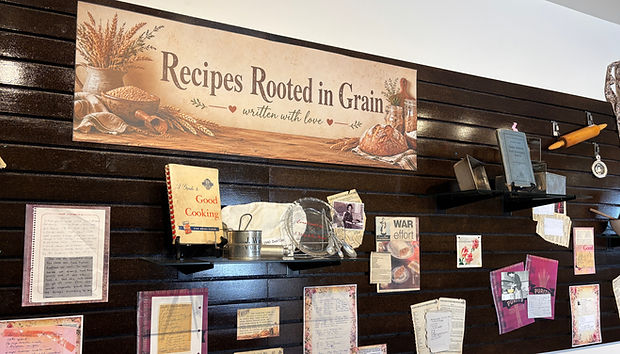
The exhibits cover a wide array of topics, including communication technologies, agricultural tools, medical advancements, military history, education and everyday life artifacts. Notable sections include the Communication Room, which showcases how information was shared over the decades, the Homesteaders exhibit, a recreation of rooms from a homestead and Prospect Slope Schoolhouse, a original one bedroom school house from within Vulcan County. Our current front house board special display, is "Recipes Rooted in Grain, Written in Love." A close to home display that shows off local bakers, cooks and recipes.

The Lewis & Ware Foyer
Nettie Ware was born on her father John Ware's ranch near Millarville, Alberta in 1893. Nettie lived there until the age of 13, when her fathers untimely death forced her family into Calgary with her grandparents. In 1921, the Ware's had enough with the city and moved out to Kirkcaldy, where Nettie's uncle Spencer Lewis, had just bought a farm. Nettie immediately became deeply ingrained in the everyday operations of the farm, and in turn became deeply ingrained with Vulcan County as a whole. When her uncle died in 1961, Nettie took over the farm. During this time she formed a connection with the Vulcan & District Historical Society. Nettie has done so much for our museum, from years of dedicated service to donating the actual funds which built our building. We use this space, directly in the building she funded, to show our gratitude.
This foyer is dedicated to the Lewis & Ware families
Most notably, Nettie Ware

Prospect Slope School
The original Prospect Slope School burned down in 1927, before being replaced later that same year by this schoolhouse brought from Vauxhall/Enchant. This schoolhouse then operated in Prospect Slope until 1944. After this it soon fell into disrepair and for over 50 years nothing was done to it. By 2000, it was sitting useless blocking good farmland. So we at the Vulcan & District Historical Society decided to do something about it. We moved it from its original standing place approximately 30 km east of present day Vulcan to our museum where it sits today. With much hard work and the guidance of an original Prospect Slope School teacher Mrs. Fath, the schoolhouse was restored to its proper glory. Please take a look through to see what schooling was like back in the day

The Bedroom
The Bedroom is one of those other essential rooms that must be in a homestead. Humans spend a large portion of the day sleeping, which usually means a large portion of the day is spent in this room. Although you don't usually relise how much time is spent in this room, sleeping is one of the most important things someone will do in a day. Everybody especially the early farmers needed a safe, and secure sleeping area such as a bedroom.
The Sewing Room
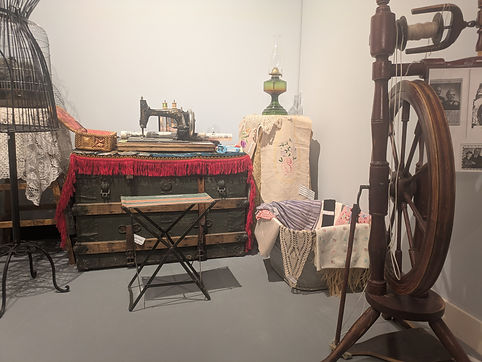
The Sewing Room is probably the second most important part of a homestead, because right after food, water, and shelter, the next most important thing is usually clothing. Whether it was making pyjamas, welding overalls, or quilts, every piece of clothing, every blanket and any item cloth related would've been made here. A sewing machine had endless use for the pioneers and early farmers, especially in the cold Albertan winters.

The Kitchen
"When I saw that house, with that huge front room, dining room, hardwood floor, beautiful kitchen. I was just absolutely amazed" - Betty Smith (Formerly Betty Hagg)
The Kitchen is one of, if not, the most essential room in a house. You don't need much to survive, but you do need a kitchen. The kitchen in our museum is our take on a homesteader's kitchen, it is full of the type of equipment the first farmers would've had and used on the prairies. What would it have been like to cook on a wood stove? or to can all your food for the winter? Today, modern conveniences making cooking much easier than it used to be.

The Pantry
You know how a lot of food says "store in a cool, dry place," well The Pantry is that cool, dry place. The pantry is a vital extension of the kitchen, without the pantry there would be a lot of problems. Although most homes today simply have a pantry cupboard, homesteads on the prairies definitely needed a whole room. The pantry served a extremely important role; a calm, consistent storage room, that didn't get too hot, cold or wet. This was the place for making butter, canning goods and storing food.

The Grain Elevator Agent's Office
"There is one thing I have to say about the grain business ... It is a dusty job"
- Ray Bagozzi (Former Elevator Agent)
The Grain Elevator Agents Office is a recreation of the office inside a wooden grain elevator. This is where the money got made, this is where the agent operated the elevator, taking in grain from farmers and filling train cars. Whether they needed to take the manlift up to do maintenance or share a cup of joe with the local farmers, it all started here.

The Barn
"There are two distinct systems of farming practised in North America today: grain farming, and livestock farming" - Excerpt from "Types and Market Classes of Live Stock"
Farming is the lifeblood of Vulcan County, without agriculture, many of these towns and communities would not exist in the same way. But farming is a very broad term, although the majority of farming in Vulcan has always been grain farming, livestock farming is just as important. In the early days, farmers relied mostly on food they grew. Back then, everybody needed a few animals to fill their plate at the end of the day. Nowadays, it is possible to specialize heavily in one area but ask any farmer and they will definitely still have a Barn with a little livestock.

The Workshop
The Workshop, probably the most important room for a good farmer to have. In the early days of farming, everything had to be made by hand or take weeks to arrive. The workshop is where that production took place. From fences, to engine parts, to furniture, every farmer spent hours in a workshop just like this, building and tinkering. We have almost every kind of tool or gadget a early farmer would've used in our workshop. And most of them still work!

The Communication Room
"In the 1950s, and 60s, the telephone operator was the hub of the community. We were always the first port of call" - Norma Lewis (Former Telephone Operator)
The Communication Room is our deep dive into our local communication history. Being located in the Alberta Government Telephone (AGT) building this room takes a look at how communication used to work across the prairies. From the telegraph, to the switchboard, to today, a lot has changed over the years but the need for long distance communication has stayed constant.

The Advocate Room
Do you remember when we used to get our news on paper? Vulcan sure does. The Vulcan Advocate was started in 1913, it was one of the first businesses in town and ran for over 110 years before ending on August 23rd, 2023. The Advocate was a staple in the communities daily lives, if you wanted to know what was going on in town or the surrounding areas then the Advocate was the first place you went. Although its not around anymore, our Archives has every paper the Advocate ever produced. This room is made possible thanks to the former owners, editors, writers and staff of the Advocate.

The Medical Room
"I can do the most good and help the most people by being a family doctor and making sure they are taken care of" - Dr. David Sessford (Former Vulcan Doctor)
The Medical Room celebrates the people who have worked tirelessly to save lives throughout Vulcan County. From Country Doctors to ER Nurses, healthcare professionals have poured in endless effort to ensure the community health of Vulcan. With this room, we hope to celebrate this usually thankless job. Please take a walk through our Medical Room to see how modern medicine has evolved. From medication to equipment, some things from the past are similar, and some things are very very different.


